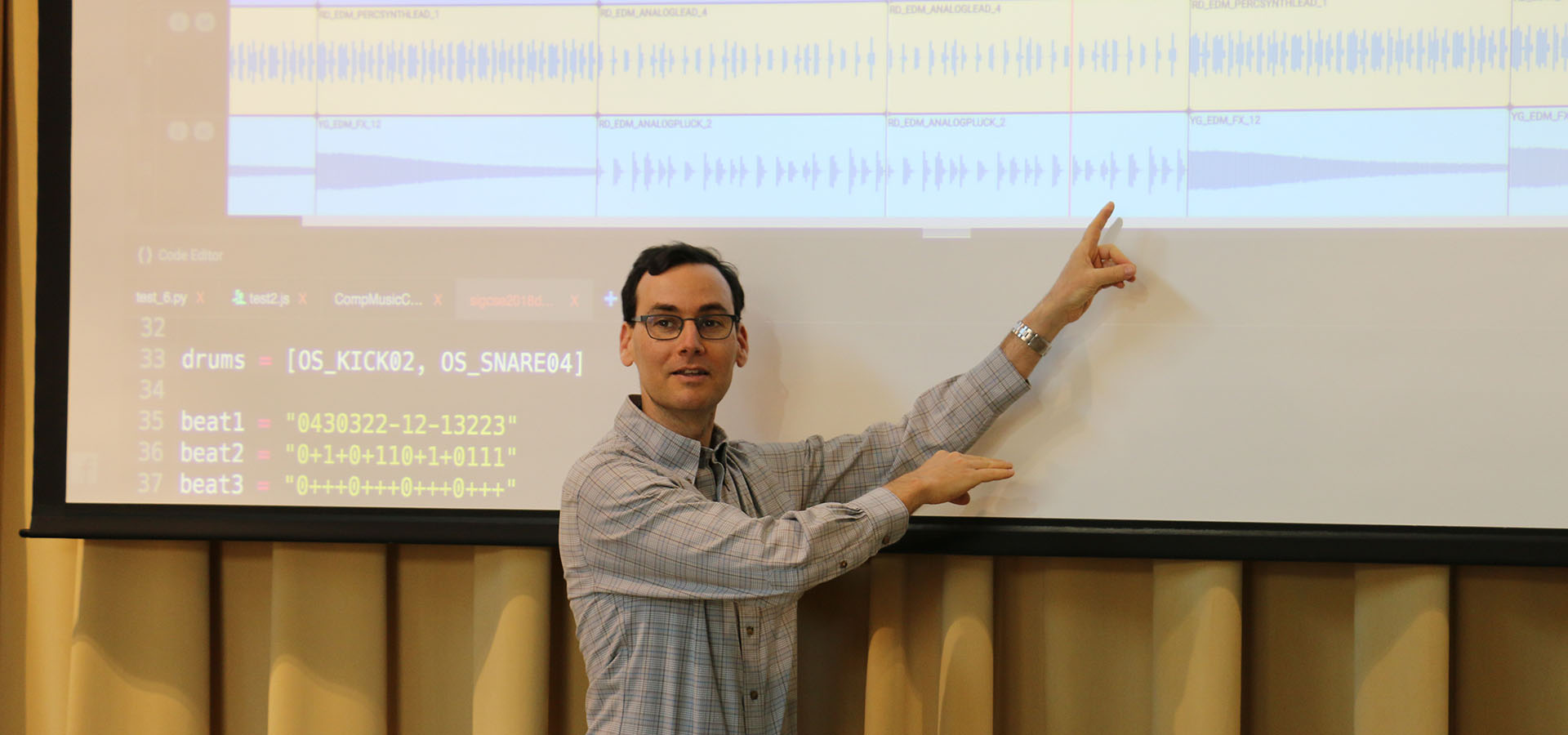
Jason Freeman lecturing in front of a class.

Jason Freeman

Professor, School of Music and Associate Vice Provost for the Arts

Jason Freeman

Professor, School of Music and Associate Vice Provost for the Arts

Area(s) of Research or Creative Practice: interactive music, computer science education, STEAM, broadening participation in computing, live coding, computer music language design

Education

D.M.A. (music composition), Columbia University, 2005
M.A. (music composition), Columbia University, 2001
B.A. (music), Yale University, 1999

Biography

Jason Freeman is the Associate Vice Provost for the Arts and a Professor of Music at Georgia Tech. His artistic practice and scholarly research focus on using technology to engage diverse audiences in collaborative, experimental, and accessible musical experiences. He also develops educational interventions in K-12 and university environments that broaden and increase engagement in STEM disciplines through authentic integrations of music and computing. His music has been performed at Carnegie Hall, exhibited at ACM SIGGRAPH, published by Universal Edition, broadcast on public radio’s Performance Today, and commissioned through support from the National Endowment for the Arts. Freeman’s wide-ranging work has attracted support from sources such as the National Science Foundation, Google, and Turbulence. It has been disseminated through over 100 refereed book chapters, journal articles, and conference publications. At Georgia Tech, Freeman previously chaired the School of Music, chaired the Georgia Tech Arts Council, organized the Guthman Musical Instrument Competition, and served as executive director of ensemble-in-residence Sonic Generator. Freeman received his B.A. in music from Yale University and his M.A. and D.M.A. in composition from Columbia University.

Statement of Teaching Interest

Professor Freeman's teaching is focused on interactive and computer music across areas such as laptop orchestra, composition, research methods, and music technology history.

Statement of Research Interest

Professor Freeman's research, through his Computational Music for All lab, focuses on

  • The design, deployment, and evaluation of learning environments that increase and broaden participation in both music-making and in STEM fields.
  • The creation of experimental musical performances and experiences that redistribute the roles of composer, performer, and listener; expose the creative process to audiences in new ways; and engage the public as musical collaborators.
  • The design and development of core technologies to enable these experiences in areas such as real-time music notation, web audio, live coding, and network music.
Recent Scholarly Work
  1. Wanzer D, McKlin T, Freeman J, Magerko B, Lee T. "Promoting intentions to persist in computing: an examination of six years of the EarSketch program." Computer Science Education. 2020; 30(4):394-419.
  2. Freeman J, Magerko B, Edwards D, Mcklin T, Lee T, Moore R. "EarSketch: engaging broad populations in computing through music." Communications of the ACM. 2019; 62(9):78-85. issn: 0001-0782
  3. McCall L., Allen B., Freeman J., Garrett S., Grossman S., Paz J., Edwards D., McKlin T., Lee T. "Developing Computational Thinking in Middle School Music Technology Classrooms." SIGCSE 2024 - Proceedings of the 55th ACM Technical Symposium on Computer Science Education; 2024; c2024. DOI: 10.1145/3626253.3635527
  4. Magerko B., Freeman J., McKlin T., Reilly M., Livingston E., McCoid S., Crews-Brown A. "EarSketch: A STEAM-based approach for underrepresented populations in high school computer science education." ACM Transactions on Computing Education. 2016; 16(4). DOI: 10.1145/2886418
  5. Moore R., Newton S.H., Alemdar M., Grossman S., Freeman J., Smith J.B., Berry T. "Engaging High School Students in Computer Science Through Music Remixing: An EarSketch-based Pilot Competition and Evaluation." ASEE Annual Conference and Exposition, Conference Proceedings; 2021; c2021.
    eid: 2-s2.0-85124532056
  6. Rahimi S, Smith J, Truesdell E, Vinay A, Boyer K, Magerko B, Freeman J, Mcklin T. "An automated, unobtrusive, formative assessment of creativity in a computer science and music remixing learning environment." Psychology of Aesthetics, Creativity, and the Arts. 2024 May 16.
  7. Griffith A.E., Katuka G.A., Wiggins J.B., Boyer K.E., Freeman J., Magerko B., McKlin T. "Investigating the Relationship Between Dialogue States and Partner Satisfaction During Co-Creative Learning Tasks." International Journal of Artificial Intelligence in Education. 2023; 33(3):543-582. DOI: 10.1007/s40593-022-00302-5
  8. McCall L., Freeman J., McKlin T., Lee T., Horn M., Magerko B. "Complementary Roles of Note-Oriented and Mixing-Oriented Software in Student Learning of Computer Science Plus Music." Computer Music Journal. 2022; 46(3):48-66.
  9. McKlin T., McCall L., Lee T., Magerko B., Horn M., Freeman J. "Leveraging Prior Computing and Music Experience for Situational Interest Formation." SIGCSE 2021 -Proceedings of the 52nd ACM Technical Symposium on Computer Science Education; 2021; c2021. DOI: 10.1145/3408877.3432431
  10. McKlin T., Lee T., Wanzer D., Magerko B., Edwards D., Grossman S., Bryans E., Freeman J. "Accounting for pedagogical content knowledge in a theory of change analysis." ICER 2019 - Proceedings of the 2019 ACM Conference on International Computing Education Research; 2019; c2019. DOI: 10.1145/3291279.3339412